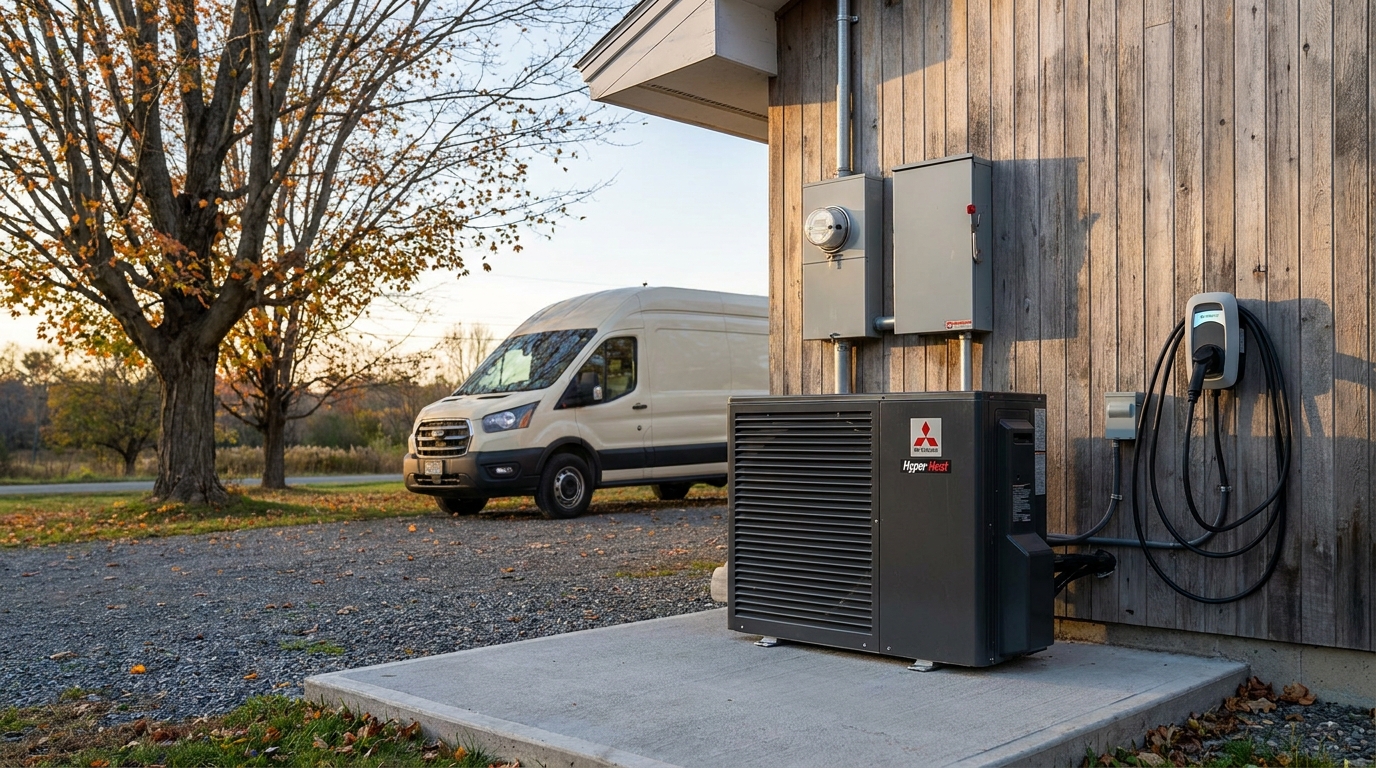
If you have decided you want to come off oil entirely — heating, hot water, eventually cooking and driving — Voltline is the firm that handles that as one coordinated project. We do not call this a "package deal." We call it a relationship.
About one in four Voltline customers does the whole-home electrification scope. Sometimes it's a new homebuyer who has just inherited a leaking oil tank. Sometimes it's a 20-year homeowner whose boiler has just died and who has decided this is the moment. Sometimes it's a multi-year renovation where the heat pump goes in this year and the water heater goes in next year when the existing tank fails.
The four pieces are sequenced. The rebates are stacked across phases. The relationship spans 6 to 18 months of touch points, and several more years of follow-up maintenance. We are not closing a transaction; we are managing a multi-phase project on your house.
The four pieces.
1 · The heat pump.
Primary heating and cooling. Either a cold-climate ducted system (if you have usable ductwork) or a multi-zone ductless system (if you don't). Mitsubishi Hyper-Heat, Fujitsu Halcyon XLTH, or Bosch IDS Premium. 36K–60K BTU/h typical, sized by Manual J on your envelope.
2 · The heat-pump water heater.
Replaces your existing oil-fired, gas, or electric resistance water heater. We install Rheem Performance Platinum or AO Smith Voltex Premier. 50, 65, or 80 gallon · COP 3.5 @ 70°F ambient · UEF 3.9. Operating cost on a typical Vermont household: ~$130/year versus ~$700/year for oil hot water.
3 · The 200A electrical panel upgrade.
Through our partner electricians at Stowe Electrical. The 200A service is what supports the full electrification stack: heat pump + HPWH + induction range + EV charger. About 65% of our customers already have 200A; 35% need an upgrade. $3,800–$5,400 for the upgrade, handled by Stowe.
4 · Induction-cooktop and EV-charger pre-wires.
We run dedicated circuits to your kitchen (240V/30A for induction) and your garage or driveway (240V/40A or 50A for an EV charger). You can install the actual induction range and EV charger later, when your budget supports them. The pre-wires set you up to do that without re-opening walls.
How we sequence it.
Phase 1 — Audit and plan (week 1–2).
A Voltline Comfort Auditor visits your home for 90 minutes. Takes measurements. Reviews your panel. Talks through your situation, occupancy, and budget. Sketches a system on paper. Files a Manual J load calc within a few business days. Returns a written quote with the full phased project plan and rebate stack within 5 business days.
Phase 2 — Heat pump and panel upgrade (month 1–2).
The biggest piece of work. We pull permits, schedule Stowe Electrical for the panel work (if needed), and execute the heat-pump install over 2–3 days. The panel upgrade and the heat-pump install can usually run back-to-back. You have heat the whole time.
Phase 3 — Heat-pump water heater (month 3–6, or when your existing tank fails).
The HPWH typically goes in 3–6 months after the heat pump, sometimes longer. We schedule this around when your existing water heater is failing or when the EVT-rebate window aligns. A 1-day install.
Phase 4 — Induction and EV pre-wires (month 6 to year 2).
When you're ready. The pre-wires take a half-day and don't require us to do everything in one go. Some customers do this with the panel upgrade in Phase 2; some wait until they're actually buying the induction range.
How rebates work across phases.
Most rebates are equipment-specific, which means they pay on each qualified piece of equipment — not on the overall project. Federal 25C has annual caps — you can claim the heat pump in year 1 and the HPWH in year 2, capturing $2,000 + $600. Efficiency Vermont pays on each piece — heat pump rebate, separate HPWH rebate, separate panel upgrade rebate. Green Mountain Power and Burlington Electric pay instant rebates on each qualified piece at quote time.
The IRA HEEHRA rebate is the exception: it has a project-total cap for income-qualified households (up to $14,000 across heat pump + HPWH + panel + induction, with a $8,000 sub-cap on the heat pump alone). If you qualify, we structure the phasing to maximize the HEEHRA capture.
The full math, including which rebates do and don't stack, is on the rebates page. The summary: typical stacked rebates on a whole-home electrification project run $10,000–$18,000.
What does it cost all-in?
Income-qualified households (HEEHRA at ≤80% AMI) see net costs in the $5,000–$10,000 range.
Why we treat this as a relationship, not a transaction.
Whole-home electrification is a multi-year project, not a same-day install. We are at your house for six visits, not one. We know your panel, your insulation, your hot-water habits, and your spouse's strong opinions about the kitchen induction range by the end of Phase 2. That context is the firm's job to hold.
Our project-completion bonus is paid at the one-year mark, not at the close. If your heat pump is performing as quoted twelve months in — measured against the projected operating cost in your Manual J — the installation team gets the bonus. If it isn't, we are at your house figuring out why, on our nickel. We have an incentive structure that aligns with your outcome, not with the close. That is on purpose.