BeforeThe 2009–2018 chapter.
I finished mechanical engineering at UVM in 2007. I went to work for a generalist Burlington HVAC firm that installed oil boilers, gas furnaces, central-air condensers, and the occasional heat pump (badly, in those years). For nine years I was a journeyman installer, a project manager, and finally the senior install lead on the residential side. I installed somewhere north of three hundred fossil-fuel heating systems in those years. Mostly oil boilers. Some propane, some gas.
Around 2017 a slow, uncomfortable realization started to settle in. Every house I was leaving with a brand-new oil boiler — a $14,000, twenty-year-service-life piece of equipment — was going to be re-converted to a heat pump before that boiler reached the end of its life. The math was already there. The cold-climate heat pumps that were being released that year were rated to perform at temperatures we never expected they could. The Vermont grid was getting cleaner. Oil prices were getting worse. The rebate landscape was changing.
I did not want my professional legacy to be six-figure homes that someone else would have to re-tool in fifteen years. The math kept getting clearer the more I looked at it.
I did not yet know how to act on the realization. I kept installing oil boilers, increasingly resentfully, through 2018.
The Turning PointThe 2018 NEEP training.
In the fall of 2018 I took the Northeast Energy Efficiency Partnerships (NEEP) cold-climate heat-pump installer certification — a multi-day technical course covering capacity-retention curves, refrigerant cycle behavior under deep-cold conditions, Manual J load-calculation methodology specific to heat-pump sizing, and the engineering data from the major cold-climate manufacturers (Mitsubishi, Fujitsu, Bosch).
The training surprised me. I had not realized how much performance data the manufacturers had already published. Mitsubishi's Hyper-Heat had verified capacity at −13°F for three years. Fujitsu's Halcyon XLTH was rated to −15°F. The numbers were real, the curves were real, and the field-data sets from cold-climate installations across New England, Quebec, and Scandinavia were starting to corroborate the lab numbers.
I left my employer that December. I spent the winter of 2018-19 walking around with a notebook, talking to electricians, talking to Efficiency Vermont staff, and figuring out what a heat-pump-only HVAC firm would look like in Burlington if it actually existed.
The FirmThe 2019 founding.
I founded Voltline in March 2019. One truck. One apprentice — Marcos Verre, then 24, who had been working as an HVAC apprentice at a different firm and decided to come with me. We did twenty-three installs in 2019. Single-family residential. Mostly ductless retrofits, some ducted, all cold-climate-spec.
The winter of 2019-20 was an early test. We had a stretch of −22°F nights in January 2020. Every one of our installs from year one kept running. We data-logged a half-dozen of them in cooperation with Efficiency Vermont. The systems pulled heat out of the air at −22°F and delivered it indoors. Some required the supplemental electric strip backup for an hour or two on the coldest nights. Most did not.
My phone has been ringing ever since. We are now eleven people, six service vans, around two hundred installs a year. We have installed 840+ cold-climate heat pumps as of this writing.
PrinciplesWhat we won't do.
Voltline does not install gas furnaces. Voltline does not install oil boilers. Voltline does not install propane heating. We will not service or maintain fossil-fuel heating systems. If your gas furnace has failed and you want it replaced with another gas furnace, we are not the firm for you, and we will gladly recommend a generalist HVAC contractor.
Voltline does not install a heat pump as a supplement to a gas furnace. We remove the fossil-fuel equipment. If your home requires supplemental backup heat for the rare deep-cold event below −15°F, we install electric resistance strip heat in the air handler — also electric. The whole heating load is on the electrical service.
Voltline does not use same-day-only pricing or pressure-close tactics. The quote is valid 90 days. If a customer takes 89 days to decide, that is fine.
Voltline does not subcontract installs. Every install is performed by Voltline-employed installers. Electrical work is done by our partner electrical firm Stowe Electrical, who we work with on every job. We do not bring in unfamiliar trades.
Who Works HereThe team.
Adrienne Beaulieu
Founder · NEEP · BPI · UVM ME '07
Founded the firm after nine years installing oil boilers. Sits on the Efficiency Vermont Heat Pump Contractor Advisory Panel.
Marcos Verre
Lead Installer (since 2019) · Mitsubishi Diamond · Fujitsu Elite
Voltline's first apprentice. Now leads the more technically difficult installs — the historic homes, the deep-cold-pocket configurations, the lakefront retrofits.
Helena Tran
Lead Installer (since 2020) · NEEP · Mitsubishi · Bosch
Joined after five years at a Montpelier firm. Bosch IDS specialist, also leads our heat-pump water heater installs.
Theo Kohl
Lead Installer (since 2021) · NEEP-certified
Started as a Voltline apprentice in 2019, made lead in 2021. Multi-zone ductless specialist.
Marisol Fender
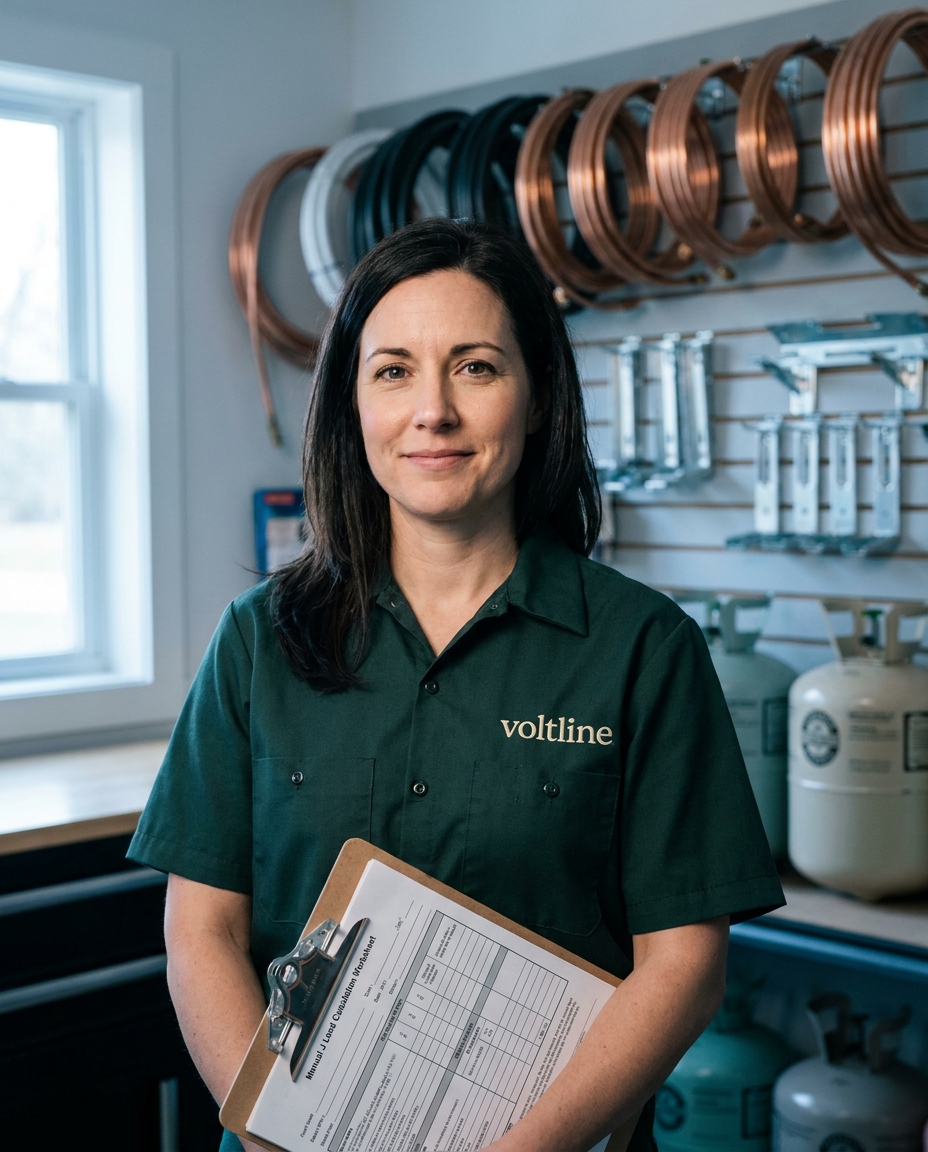
Comfort Auditor (lead) · NEEP · Manual J specialist
Runs the load-calc and system-design work. Most of the engineering quality of a Voltline install starts on her clipboard.
James Park
Comfort Auditor · BPI-Certified · Former EVT rebate processor
Spent four years processing Efficiency Vermont rebates from the inside. Knows the paperwork better than the paperwork knows itself.
Sera Walsh
Apprentice, year 2
Mid-program. Will sit for the NEEP cold-climate certification this fall.
Nico Reyes
Apprentice, year 1
Started October 2025. Came over from a residential electrical apprenticeship.
Jules Vermette
Office Manager
Schedules every install, files every rebate, answers the phone if everyone else is on a roof. Joined 2021.
Why This WorkThe climate position.
The home heating sector is one of the larger contributors to U.S. residential carbon emissions. The technical pathway to cutting it is reasonably clear: electrify the heating load, and source the electricity from a grid that gets cleaner every year. Vermont's grid is already among the cleanest in the country — roughly two-thirds carbon-free generation, growing.
We are not climate activists. We are an HVAC contractor with a particular technical scope. Our customers come to us for a working heating system at a fair price, and they get one. The fact that the equipment we install also happens to cut their household's heating-related carbon emissions by 60–80% is real but is not what we lead with on the sales call. We lead with the rebate math, the operating cost, and the comfort improvement.
We will not, however, walk back from the scope of the firm to install fossil-fuel equipment for a customer who asks. There are plenty of contractors who will. We are something more specific, on purpose.
Thank you for reading. — Adrienne Beaulieu, Founder