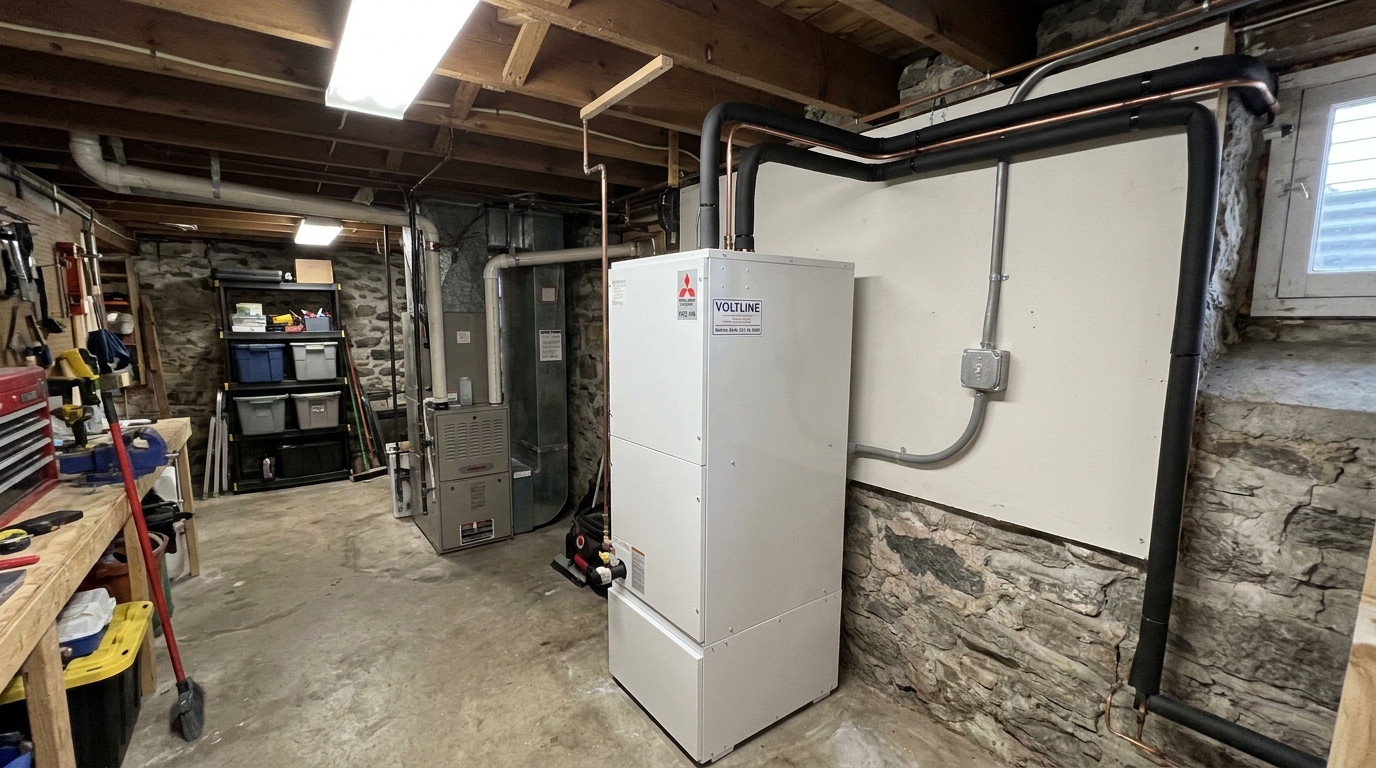
What this install is.
A full-system replacement of your existing forced-air furnace with a cold-climate variable-speed heat pump. The existing furnace is removed and disposed of. A new outdoor heat pump (Mitsubishi Hyper-Heat, Fujitsu Halcyon XLTH, or Bosch IDS) is set on a concrete pad outside. A new indoor air handler is installed in the existing furnace footprint. A refrigerant line set is run between them. Electrical service is upgraded if needed. The existing ductwork stays — after we verify it.
This is not a "hybrid" install. We do not leave a fossil-fuel furnace in place as a backup. The fossil-fuel equipment leaves the property. The entire heating load goes onto the electrical service.
We do this install style for roughly 40% of the homes we serve — the ones with usable existing ductwork. The other 60% are ductless mini-split installs, because most Vermont homes built before 1990 do not have central ducted forced-air infrastructure.
What equipment we install for ducted retrofits.
What our install includes.
A Manual J load calculation on your envelope — not on the existing furnace's nameplate. A Manual D static-pressure verification on your ductwork (and any duct sealing required for the heat-pump's lower static-pressure operating point). Equipment selection with full model numbers and capacity tables. Electrical service review and a panel-upgrade quote (through Stowe Electrical) if your existing service won't support the heat-pump amperage. Removal and disposal of your existing furnace.
Refrigerant line set sizing, installation, and pressure testing. Indoor air handler installation in the existing furnace footprint with electrical, condensate, and refrigerant connections. Outdoor unit installation on a sloped concrete pad above the average snow line, with hurricane-rated mounting brackets and vibration-isolation pads.
Commissioning at the end of the install — refrigerant charge verification, superheat and subcooling measurement, COP verification on the running system, manufacturer registration for warranty, and a 30-minute customer system orientation walkthrough so you know what the thing is doing and how to use it.
How long does the install take?
One to two days on site for the heat-pump work itself. Three days if a 200A panel upgrade is involved (Stowe Electrical handles that piece on the second day; we resume on day three). The customer has heat the whole time — we do not leave the house cold overnight.
What does it cost?
All prices before rebates. Stacked rebates typically reduce by $6,000–$14,000 — see rebate scenarios.
What rebates apply?
Four sources stack on a cold-climate ducted retrofit. The federal 25C tax credit caps at $2,000 for heat pumps; it's claimed on next year's tax return (IRS Form 5695). The Efficiency Vermont rebate is typically $4,000 on a cold-climate retrofit, paid at install — Voltline files this paperwork for you. The Green Mountain Power instant rebate is $1,200, applied at quote (Burlington Electric customers have a parallel program, $1,500). The IRA HEEHRA point-of-sale rebate is up to $8,000 for income-qualified households at ≤150% AMI (full at ≤80%) — NOT stackable with 25C on the same equipment, but stackable with state and utility.
Full math, three scenario walkthroughs, and a HEEHRA qualification estimator on the rebates page.
The published cold-climate COP curves are real. We have 5 years of installations across Burlington, including 47 we've data-logged in cooperation with Efficiency Vermont. The systems do what the manufacturers say they do.
How does it perform at temperature?
The COP curve on a Mitsubishi PUZ-HA42 holds COP 2.4 at 5°F outdoor temperature, COP 2.0 at −5°F, and COP 1.7 at −13°F. Below that the unit continues producing heat, but capacity falls below the home's heating demand on the coldest nights. That is the configurable design decision: backup or no backup.
We size based on a Manual J on the actual envelope at Burlington's 99% design temperature of −7°F. The heat pump alone covers the full load down to that design temperature on most of our installs. For homes in colder pockets (Underhill, Bolton, Charlotte ridges), we configure supplemental electric strip backup.
What about backup heat?
For Manual J design temperatures above −10°F, we usually do not install supplemental backup. The heat pump covers the load. For design temperatures below −10°F, we install electric resistance strip heat integrated into the air handler — a 10kW or 15kW electric coil that the controller engages automatically when the heat pump can't keep up.
The strip runs only when needed. On a typical install with strip backup, the strip will run for somewhere between 8 and 60 hours per heating season — not days. Operating cost during strip operation is higher than the heat pump alone, but the strip is sized to be the exception, not the rule.
The strip is electric. There is no fossil-fuel piece in the system. The whole heating load is on the electrical service.